

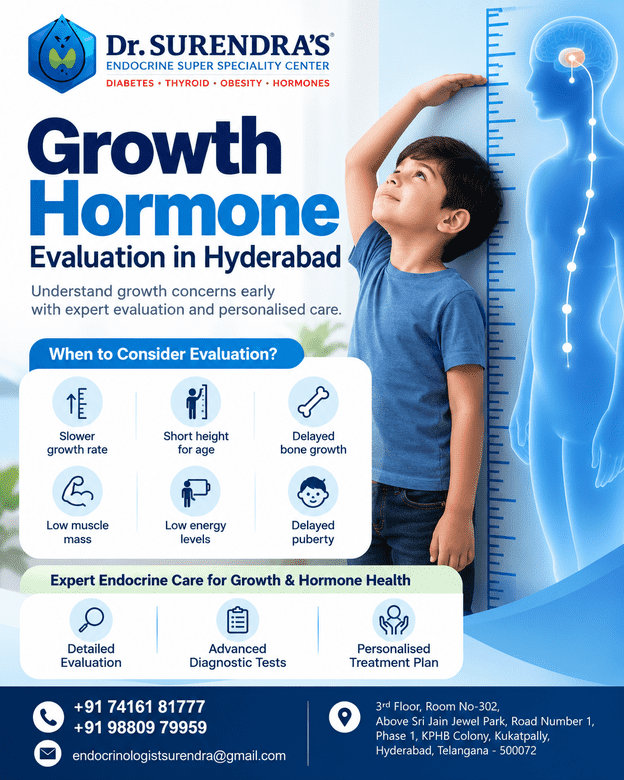
Growth hormone evaluation in Hyderabad by Dr. Surendra Prasad Guntupalli, Senior Consultant Endocrinologist, provides structured, evidence-based diagnostic assessment for children experiencing slow height velocity and adults with suspected pituitary disorders. Evaluation incorporates standardized stadiometer growth velocity tracking, bone age radiography, IGF-1 and IGFBP-3 laboratory testing, and confirmatory dynamic growth hormone stimulation tests conducted under close clinical monitoring.
Introduction: Understanding Growth and Hormone Balance
While human growth follows predictable developmental milestones, each child possesses a unique genetic trajectory determined by parental height potential. However, when height progression stalls or slows noticeably over time, a structured medical evaluation becomes essential to distinguish normal biological variations from underlying endocrine disorders.
Growth hormone (GH), synthesized and secreted by the pituitary gland at the base of the brain, acts as a primary hormonal conductor of linear bone growth, muscle synthesis, and metabolic balance. Consulting an experienced endocrinologist for a comprehensive Growth Hormone Consultation ensures timely, evidence-based investigation while avoiding unmonitored or unnecessary interventions.
- Normal childhood linear growth depends on harmonious interaction between hormones, nutrition, genetics, and overall organ function
- Growth velocity (rate of height gain per year) is often a more critical clinical metric than a single absolute height measurement
- Suspected growth issues require careful evaluation by a qualified endocrinologist before any conclusions can be drawn
- Early clinical identification before growth plate closure (epiphyseal fusion) ensures the greatest opportunity for successful medical support
- Not every child with below-average height has a hormonal disorder or requires medical therapy
What Is Growth Hormone?
Secretion of growth hormone occurs in distinctive, pulsatile bursts throughout the 24-hour cycle, orchestrated by two hypothalamic regulatory hormones: Growth Hormone-Releasing Hormone (GHRH), which stimulates release, and Somatostatin, which inhibits it. The largest and most robust pulses of growth hormone take place during deep, slow-wave sleep (stages 3 and 4) at night.
Once secreted into circulation, growth hormone travels to the liver and peripheral tissues, where it stimulates the synthesis of Insulin-Like Growth Factor 1 (IGF-1). It is primarily IGF-1 that acts directly upon the epiphyseal growth plates of long bones, stimulating chondrocyte proliferation and bone lengthening, while growth hormone itself directly promotes lipolysis (fat breakdown) and lean muscle development.
- Produced by somatotroph cells in the anterior pituitary gland under hypothalamic control
- Secreted in intermittent pulses, with predominant surges occurring during deep nighttime sleep
- Stimulates hepatic production of IGF-1, the key biological mediator of bone elongation
- Regulates lipid mobilization, lean muscle maintenance, and insulin sensitivity across all ages
- Maintains vital physiological balance between nitrogen retention and energy expenditure
What Are the Signs of Growth Hormone Deficiency?
It is crucial to recognize that growth hormone deficiency cannot be diagnosed from visual appearance or isolated symptoms alone. A comprehensive auxological assessment and structured endocrine testing are mandatory to confirm the condition.
- Subnormal growth velocity compared to age- and sex-matched developmental standards
- Noticeable deviation downward across standardized growth chart percentiles
- Immature facial features and delayed dental eruption in younger children
- Altered body composition characterized by increased central adiposity and reduced muscle tone
- Non-specific physical manifestations requiring objective laboratory and radiological verification
Signs in Children
In infants, severe congenital growth hormone deficiency may present with prolonged conjugated jaundice, recurrent hypoglycemia (low blood sugar), and, in newborn boys, micropenis. As children grow into early and mid-childhood, the predominant hallmark is slow height velocity—typically gaining less than 4 to 5 centimeters per year after the age of three.
Children with GHD usually exhibit normal body proportions (they appear appropriately proportioned but significantly younger than their chronological age). They may have a youthful, cherubic facial appearance with a prominent forehead, delayed primary and secondary tooth eruption, fine hair, and a tendency toward mild truncal adiposity despite poor height progress. Pubertal maturation is frequently delayed.
Signs in Adults
Adult Growth Hormone Deficiency (AGHD) may represent childhood-onset deficiency persisting into maturity or adult-onset deficiency acquired through pituitary pathology. In adults, GHD does not affect height (since bone growth plates are already fused) but instead manifests as profound metabolic and body composition changes.
Symptoms include reduced exercise capacity, persistent chronic exhaustion, loss of lean skeletal muscle mass, increased visceral abdominal fat, diminished bone mineral density (osteopenia or osteoporosis), and adverse cardiovascular lipid profiles. However, adults presenting with non-specific fatigue or gradual weight gain do not automatically have growth hormone deficiency; structured testing is indicated only in individuals with confirmed pituitary disease or high clinical risk.
What Causes Growth Hormone Deficiency?
Congenital GHD arises from genetic anomalies affecting pituitary transcription factors (such as PROP1, POU1F1, or HESX1), structural midline brain defects, or pituitary gland hypoplasia (such as septo-optic dysplasia). These children may exhibit isolated growth hormone deficiency or combined pituitary hormone deficiency (CPHD), affecting multiple endocrine axes.
Acquired GHD results from external damage to the hypothalamic-pituitary architecture. Frequent causes include benign intracranial tumors such as craniopharyngiomas or pituitary adenomas, neurosurgical interventions, cranial radiotherapy for childhood malignancies, severe traumatic brain injury, or central nervous system infections. When no structural or genetic cause is identified despite thorough investigation, the condition is classified as idiopathic GHD.
- Congenital / Genetic: Mutations in GHRH receptor, GH1 genes, or pituitary developmental transcription factors
- Structural Anomalies: Pituitary hypoplasia, ectopic posterior pituitary, or septo-optic dysplasia
- Intracranial Lesions: Craniopharyngiomas, pituitary adenomas, dysgerminomas, or Rathke's cleft cysts
- Medical Therapies: Cranial irradiation for leukemia or central nervous system tumors, and pituitary surgery
- Traumatic & Inflammatory: Severe head trauma, perinatal birth asphyxia, lymphocytic hypophysitis, or histiocytosis
- Idiopathic: No identifiable structural or genetic lesion discovered on neuroimaging
How Is Growth Hormone Deficiency Diagnosed?
An experienced endocrinologist begins with detailed auxology—the systematic measurement and scientific analysis of physical growth parameters over time. Serial accurate measurements collected on a calibrated wall-mounted stadiometer provide essential data on height velocity, which is plotted meticulously against standardized national and World Health Organization (WHO) growth charts.
To initiate a thorough evaluation for your child or loved one, booking an Endocrinology Consultation with Dr. Surendra Prasad Guntupalli in KPHB, Kukatpally provides a clear, medically sound diagnostic roadmap tailored to individual clinical requirements.
- A single random daytime growth hormone blood test is medically inaccurate due to pulsatile secretion
- Accurate stadiometer height velocity tracking over a 6 to 12-month interval is the cornerstone of clinical evaluation
- Target genetic height calculation (mid-parental height) helps determine appropriate expected growth trajectories
- Left hand and wrist radiography provides objective skeletal bone age assessment
- Baseline IGF-1 and IGFBP-3 laboratory assays reflect cumulative daily growth hormone biological activity
Medical History and Growth Assessment
The endocrinologist records an exhaustive personal and family medical history, including birth weight, gestational age, neonatal hypoglycemia, past childhood illnesses, nutritional habits, and parental growth history (such as delayed pubertal growth spurts in parents).
Mid-parental target height is calculated using standardized sex-adjusted formulas: for boys, [(Mother's height + 13 cm) + Father's height] / 2; for girls, [(Father's height - 13 cm) + Mother's height] / 2. A plain radiograph of the left hand and wrist is obtained to determine skeletal bone age using the Greulich and Pyle atlas. In children with GHD, bone age is consistently delayed relative to chronological age, reflecting biological potential for further growth.
IGF-1 Blood Test (Insulin-Like Growth Factor 1)
Because circulating IGF-1 concentrations remain relatively stable throughout the day bound to IGF-binding protein 3 (IGFBP-3), measuring serum IGF-1 serves as a reliable initial screening assessment. Normal laboratory reference ranges must be rigorously adjusted for age, sex, and pubertal Tanner stage.
A markedly subnormal IGF-1 level strongly supports the suspicion of GHD in a child with documented growth failure. However, a normal IGF-1 level does not completely exclude growth hormone deficiency in all clinical situations, and low IGF-1 can also stem from poor nutritional intake, celiac disease, or liver dysfunction, requiring cautious clinical interpretation.

Specialized clinical growth assessment, bone age screening, and pediatric endocrine evaluation for slow growth and suspected growth hormone deficiency at Dr. Surendra's Endocrine Super Speciality Center in KPHB, Kukatpally.
Growth Hormone Stimulation Test (Provocative Testing)
Because resting growth hormone levels are naturally low, pharmacological stimuli are administered in a controlled clinical environment to prompt the pituitary gland to release its maximum reserve of growth hormone. Standard stimulating agents include clonidine, glucagon, L-arginine, or insulin (the Insulin Tolerance Test). Blood samples are drawn through an intravenous catheter at scheduled intervals (such as 0, 30, 60, 90, and 120 minutes) to track the hormonal peak.
Clinical practice guidelines generally require failure to achieve a defined peak growth hormone concentration (conventionally below 7 to 10 ng/mL, depending on laboratory assay standards) across two distinct provocative tests to establish a definitive diagnosis of growth hormone deficiency.
- Performed exclusively under direct medical supervision with continuous vital sign and blood glucose monitoring
- Utilizes validated pharmacological stimulants such as clonidine, glucagon, or arginine to provoke pituitary release
- Serial blood samples collected over 2 to 3 hours delineate the dynamic somatotropic response curve
- Consensus guidelines typically require subnormal peak responses on two separate provocative tests for confirmation
- Sex-steroid priming may be utilized in peripubertal boys and girls to avoid false-positive subnormal results
Additional Hormone Tests
Before performing provocative testing, other systemic and endocrine causes of growth failure must be rigorously investigated and excluded. In particular, untreated primary hypothyroidism can suppress pituitary growth hormone release and delay bone development. A comprehensive Thyroid Disorders Evaluation measuring TSH and Free T4 is mandatory, as correcting thyroid dysfunction often restores normal growth velocity without any need for GH therapy.
Additional laboratory evaluations include morning serum cortisol or ACTH to evaluate adrenal axis integrity, prolactin levels, celiac disease screening (anti-tTG IgA), renal and liver function panels, and karyotyping in girls with unexplained short stature to rule out Turner syndrome.
MRI or Other Investigations
Once biochemical growth hormone deficiency is established, high-resolution contrast-enhanced Magnetic Resonance Imaging (MRI) of the brain and pituitary gland (sella turcica) is strongly recommended.
Neuroimaging visualizes the pituitary architecture, assessing the size of the anterior lobe, the presence of the normal posterior pituitary bright spot, and the structural integrity of the pituitary infundibular stalk. It also reliably rules out craniopharyngiomas, optic chiasm gliomas, or Rathke's cleft cysts that may compromise pituitary hormonal output.
When Should a Child Be Evaluated for Slow Growth?
A child whose height falls persistently below the 3rd percentile for their age and gender, or whose height is significantly discordant with their genetic family target height, should undergo structured medical review.
Furthermore, any noticeable deceleration in height velocity—such as gaining less than 4 to 5 cm annually between age four and puberty, or crossing two or more major percentile lines downward on a standardized growth chart—warrants prompt investigation by a specialist in Growth & Pubertal Disorders.
- Height plotted below the 3rd percentile on standardized WHO or national growth charts
- Height velocity less than 4 cm per year after the age of three years
- Loss of height percentiles (downward crossing of percentiles over 6 to 12 months)
- Height markedly below the calculated mid-parental genetic potential (more than 2 standard deviations below target)
- Severe short stature accompanied by delayed puberty, prolonged neonatal hypoglycemia, or microphallus
- History of cranial irradiation, brain tumor, or severe traumatic head injury with slowing growth
Is Growth Hormone Treatment Necessary for Everyone With Short Stature?
The two most common causes of below-average childhood height are Familial Short Stature (where children are naturally short because their parents are short, but grow at a normal annual rate and enter puberty on schedule) and Constitutional Delay of Growth and Puberty (often termed 'late bloomers,' who exhibit delayed bone age and delayed puberty but eventually achieve normal adult height). Neither of these benign variants requires growth hormone treatment.
Recombinant human growth hormone (rhGH) therapy is approved only for medically documented growth hormone deficiency and specific validated medical indications, such as Turner syndrome, Prader-Willi syndrome, Small for Gestational Age (SGA) infants who fail to catch up by age 2 to 4, and Chronic Kidney Disease.
Medical Safety Reminder: Growth hormone should not be used without medical supervision to increase height, build muscle or improve athletic performance. Not every patient requires every available test, and therapy must be instituted strictly under specialist oversight with regular monitoring.
- Familial short stature and constitutional growth delay are benign variations that do not require hormone therapy
- Growth hormone is prescribed solely for medically confirmed deficiency and approved international clinical indications
- Therapy involves daily subcutaneous micro-injections using specialized, virtually painless pen delivery devices
- Regular clinical follow-up monitors height velocity, bone maturation, serum IGF-1, thyroid levels, and glucose metabolism
- Treatment is continued only while long-bone growth plates remain open and responsive to physiological somatotropic stimulation
- Unapproved usage for cosmetic enhancement, bodybuilding, or sports performance carries serious medical risks
What Happens During an Endocrinology Consultation?
During the consultation, Dr. Surendra Prasad Guntupalli conducts an exhaustive review of previous growth measurements, birth history, nutritional status, and family growth patterns. A detailed clinical examination evaluates body proportions, upper-to-lower segment ratios, facial morphology, pubertal development (Tanner staging), and signs of underlying systemic conditions.
Based on objective findings, a personalized diagnostic roadmap is formulated. If diagnostic testing is warranted, the endocrinologist explains each recommended test clearly, ensuring parents understand why each step is necessary and what the results indicate. To schedule a comprehensive evaluation, visit our Contact & Appointment Booking page.
- Detailed review of past pediatric growth records, birth history, and parental growth milestones
- Precision wall stadiometer height and sitting height measurements with body proportion analysis
- Pubertal Tanner staging and screening for signs of thyroid, pituitary, or syndromic disorders
- Transparent, step-by-step explanation of indicated laboratory tests, bone age radiographs, or neuroimaging
- Collaborative, patient-centric guidance focused on reassurance, scientific rigor, and patient safety
Growth Hormone Evaluation in KPHB, Kukatpally, Hyderabad
Led by Dr. Surendra Prasad Guntupalli, MD (General Medicine), DM (Endocrinology), the center provides comprehensive evaluations for growth disorders, delayed puberty, Pituitary Disorders, and complex hormonal imbalances. With super-specialist training from premier endocrine institutes, Dr. Surendra applies internationally benchmarked clinical protocols to ensure accurate diagnosis and ethical, individualized care.
The clinic is equipped with modern diagnostic facilities, standardized stadiometers, and access to advanced hormone assays, making it a trusted destination for patients seeking definitive answers for growth and endocrine health.
- Super-specialist care delivered by Dr. Surendra Prasad Guntupalli, DM (Endocrinology)
- Standardized auxological tracking, precision stadiometry, and advanced diagnostic protocols
- Thorough evaluation of growth hormone deficiency, thyroid disorders, and pituitary conditions
- Conveniently accessible clinic location in KPHB Phase 1, Kukatpally, Hyderabad
- Transparent, ethical medical counseling with zero compromise on safety or clinical integrity
Clinic Details & Appointment Information
Clinic Address: 3rd Floor, Room No-302, Above Sri Jain Jewel Park, Road Number 1, Phase 1, KPHB Colony, Kukatpally, Hyderabad, Telangana – 500072.
Contact Numbers: +91 74161 81777 and +91 98809 79959. Email: endocrinologistsurendra@gmail.com.
Patients can explore patient education videos and clinical insights on our official YouTube Channel (https://www.youtube.com/@SurendraEndocrinologist) and follow health updates on Instagram (https://www.instagram.com/dr_surendra.endocrine_center).
- Prime location in KPHB Phase 1 with elevator facility and comfortable patient waiting area
- Direct appointment booking via phone, WhatsApp, or online appointment form
- Morning and evening consultation slots available with prior appointment
- Comprehensive on-site and partnered diagnostic testing facilities for hormone panels
Conclusion: Timely Evaluation for Long-Term Health
A structured evaluation by a qualified endocrinologist replaces guesswork and anxiety with objective clinical clarity. Whether your child simply requires reassurance and nutritional optimization for constitutional delay, or needs targeted therapy for verified growth hormone deficiency, early specialist assessment ensures that every child receives the right care at the right time.
Take proactive steps for your family's endocrine well-being. Schedule a consultation today with Dr. Surendra Prasad Guntupalli at Dr. Surendra's Endocrine Super Speciality Center in Kukatpally, Hyderabad.
- Growth plates close permanently following pubertal maturation, making early timing critical
- Objective stadiometer growth velocity analysis distinguishes benign delay from endocrine pathology
- Qualified endocrinologists ensure safe, evidence-based management without unnecessary interventions
- Personalized care supports both physical development and psychological self-confidence in growing children
Frequently Asked Questions
These answers reflect current clinical practice guidelines from the Endocrine Society and the Growth Hormone Research Society.
Medical Education Disclaimer
This article is for patient education only and does not replace a physical consultation with a qualified doctor. Hormone regimens, blood sugar targets, and thyroid medications must be individually calibrated by an endocrinologist after proper laboratory diagnostic evaluation.
Medical References & Clinical Guidelines
- Endocrine Society — Evaluation and Treatment of Adult Growth Hormone Deficiency: An Endocrine Society Clinical Practice Guideline.
- NCBI Bookshelf — Growth Hormone Stimulation Tests in Assessing Adult Growth Hormone Deficiency: StatPearls Publishing.
- Growth Hormone Research Society (GHRS) Consensus Guidelines for the Diagnosis and Treatment of Growth Hormone Deficiency in Childhood and Adolescence.
Frequently Asked Questions
A qualified Endocrinologist (specifically a Pediatric or Adult Endocrinologist with DM training) is the medical specialist who evaluates, diagnoses, and manages growth hormone deficiency and related pituitary disorders.
Concerned About Growth or Hormone Development?
Consult Dr. Surendra Prasad Guntupalli for growth, pituitary and endocrine evaluation in KPHB, Kukatpally.